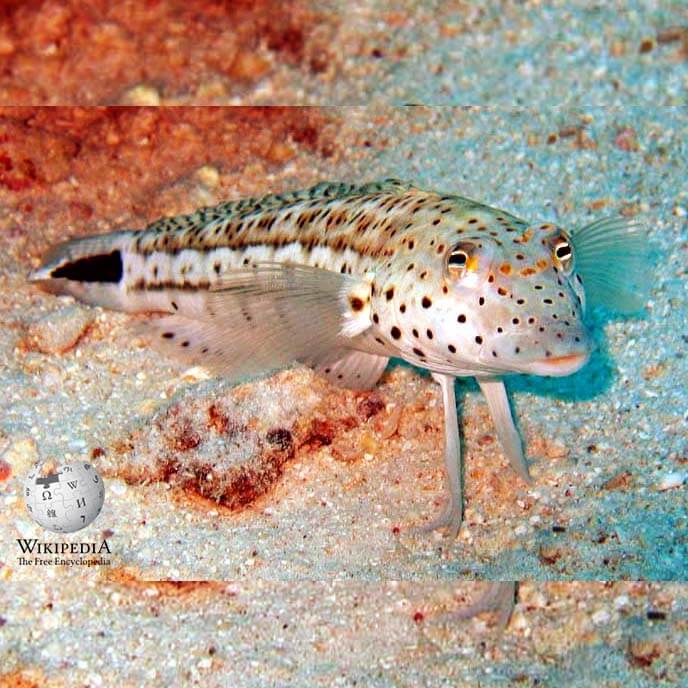
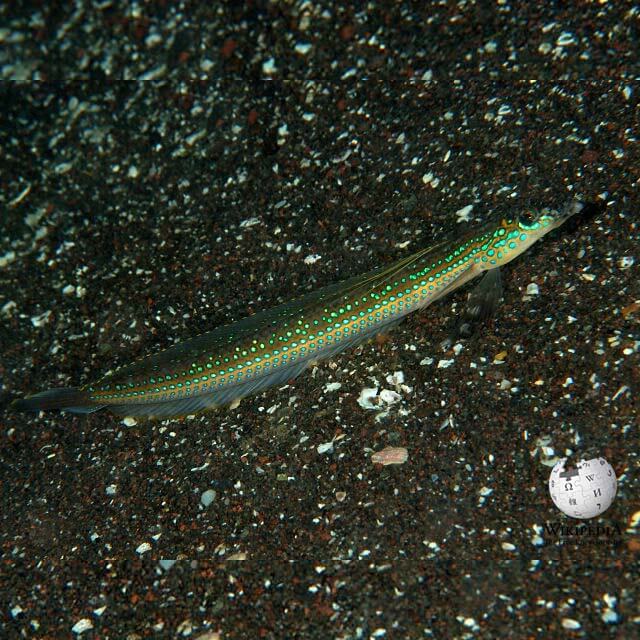


The spotted sand-diver (Trichonotus setiger) is a species of marine ray-finned fish belonging to the family Trichonotidae, the sand-divers. It is found through much of the Indo-West Pacific.
Taxonomy
The spotted sand-diver was first formally described in 1801 by the German naturalists Marcus Elieser Bloch and Johann Gottlob Schneider with its type locality given as "India orientali", which means either Indonesia or Nagasaki Prefecture, Kyushu in Japan.[2] When Bloch and Schneider described this species they also named the genus Trichonotus with T. setiger being its type species by monotypy. Trichonotus is the only genus in the monotypic family Trichonotidae.[3] Trichonotidae is the only family in the monotypic suborder Trichonotoidei within the order Gobiiformes, which also contains the cardinalfishes and gobies.[4]
Etymology
The spooted sand-diver is the type species of the genus Trichonotus, this name puts trichos, meaning "hair", in front of notus meaning "back", an allusion to the filamentous dorsal fin spines of males of the type species of the genus. The specific name, setiger, means to "bear hair or bristles", thought to be an allusion to the greatly elongated, filamentous dorsal fin spines in males.[5]
Description
Spotted sand-divers reach a maximum length of 22 cm (8.7 in). They have 39 to 41 soft dorsal rayss. Males can be distinguished from females by their long dorsal fin rays and larger size. This species has an elongated body shape and it reaches a maximum total length of 22 cm (8.7 in).[6]
Distribution
The spotted sand-diver has a wide Indo-Pacific range and it can be found from the Persian Gulf to Queensland and Melanesia[7]
Habits
Spotted sand-divers occur in large groups where there are steep sand slopes. They hover above clean sandy substrates and dive into the sand when disturbed. The habitat usually contains some silt. They are normally observed resting on sea bed, leaving substrate to catch zooplankton, or to display.[6] Some species in the genus Trichonotus are protogynous hermaphrodites.[8]
References
- ↑ Carpenter, K.E. & Smith-Vaniz, W.F. (2017) [errata version of 2016 assessment]. "Trichonotus setiger". IUCN Red List of Threatened Species. 2016 e.T69739648A115473191. doi:10.2305/IUCN.UK.2016-3.RLTS.T69739648A69742689.en.
- 1 2 3 Fricke, Ron; Eschmeyer, William N. & van der Laan, Richard (eds.). "Species in the genus Trichonotus". Catalog of Fishes. California Academy of Sciences. Retrieved 14 November 2026.
- ↑ Fricke, Ron; Eschmeyer, William N. & van der Laan, Richard (eds.). "Genera in the family Trichonotidae". Catalog of Fishes. California Academy of Sciences. Retrieved 14 November 2026.
- ↑ "Eschmeyer's Catalog of Fishes Classification". California Academy of Sciences. Retrieved 14 November 2026.
- ↑ Christopher Scharpf (24 February 2026). "Family TRICHONOTIDAE Günther 1861 (Sanddivers)". The ETYFish Project Fish Name Etymology Database. Christopher Scharpf. Retrieved 14 November 2026.
- 1 2 Froese, Rainer; Pauly, Daniel (eds.). "Trichonotus setiger". FishBase. February 2018 version.
- ↑ Randall, J.E., Allen, G.R. & Roger C.S. (eds.) Fishes of the Great Barrier Reef and Coral Sea. Honolulu, HI: University of Hawaii Press, 1996. 358.
- ↑ Kusen, J.D.; Nakagawa, K.; Yogo, Y. & Nakazono, A. (1991). "Protogynous hermaphroditism in the sand diver Trichonotus filamentosus". Nippon Suisan Gakkaishi. 57 (1): 35–40. doi:10.2331/suisan.57.35.