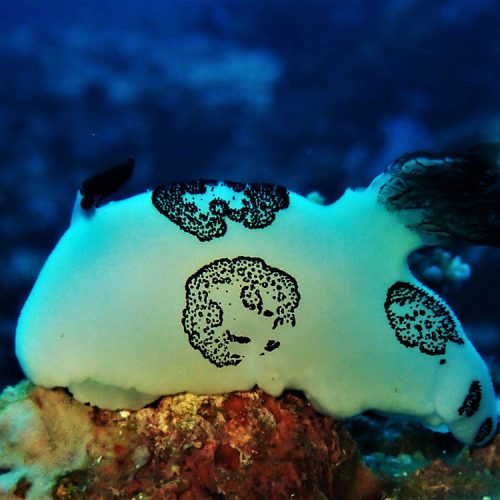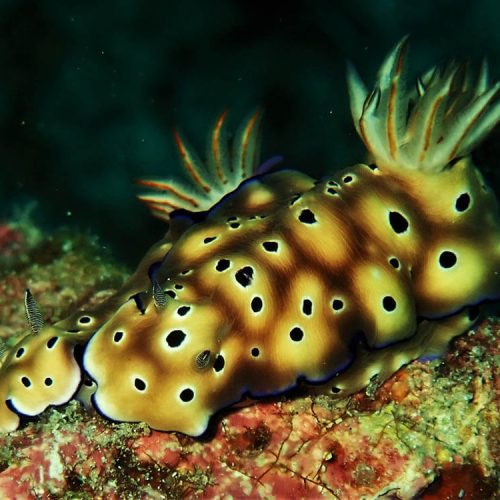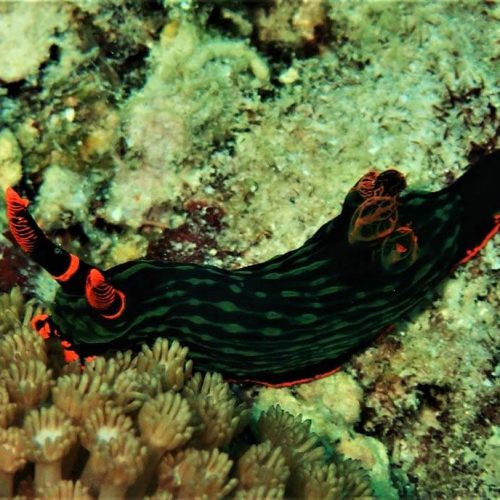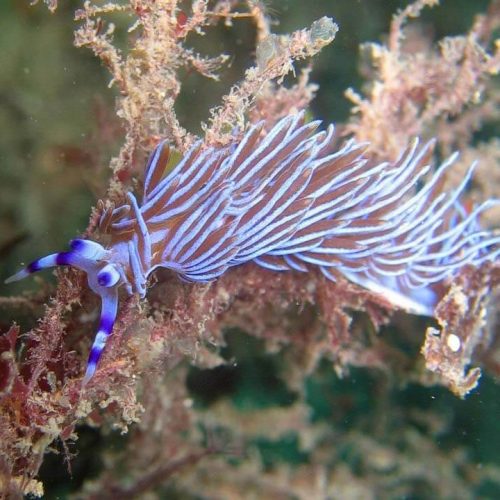
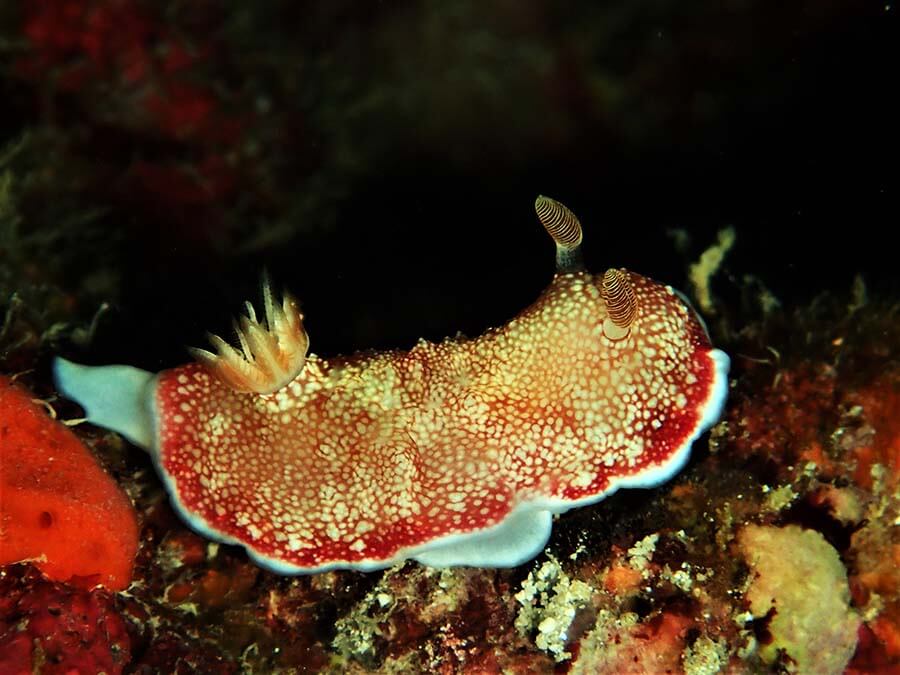

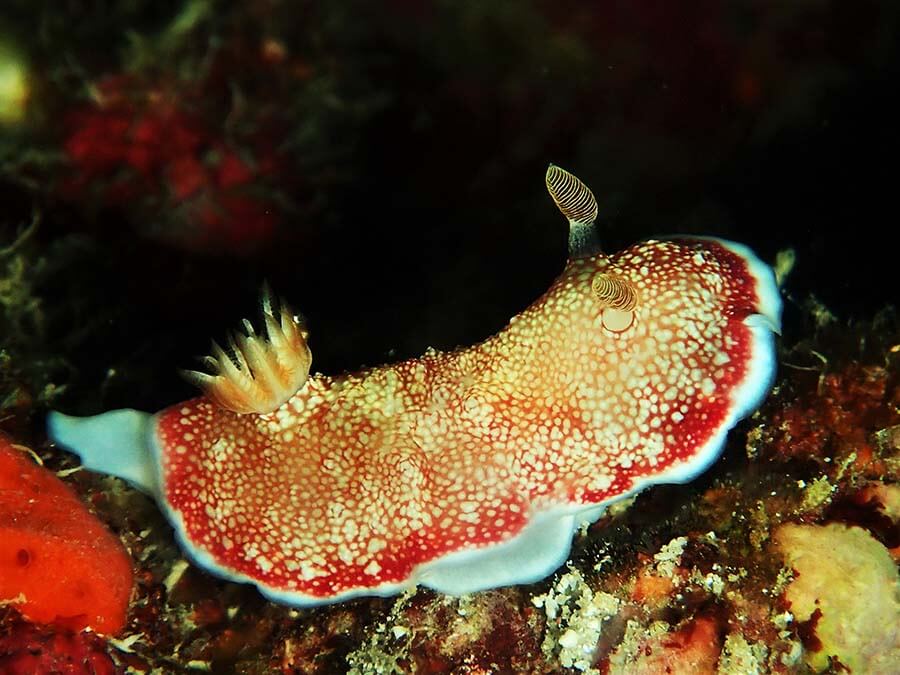
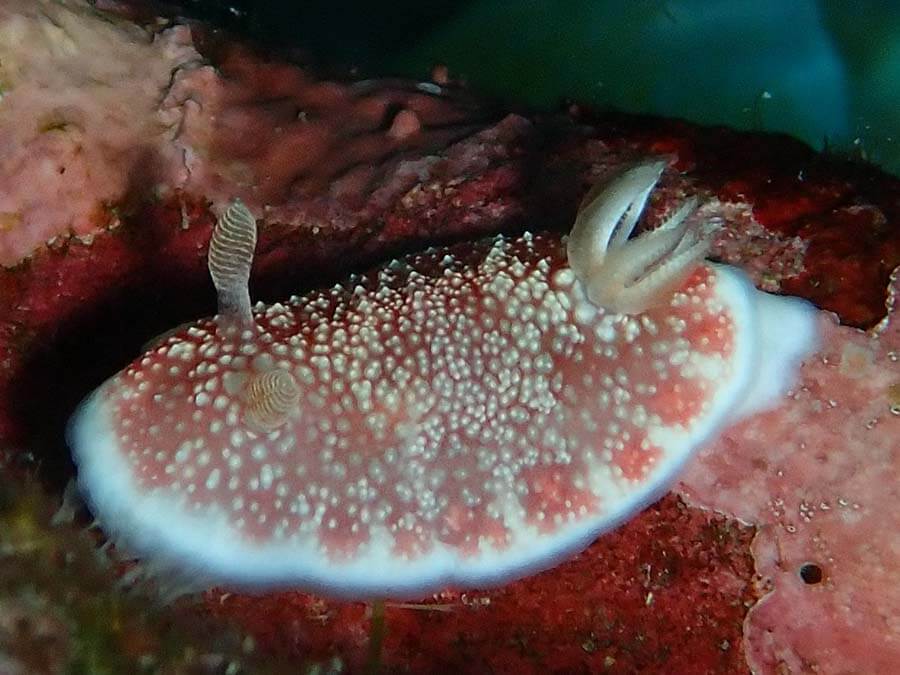


Goniobranchus reticulatus is a species of colourful sea slug in the family Chromodorididae.[1][3]
Distribution
This species was described from Tongatapu.[2][1] It has been widely reported from the Indo-West Pacific Ocean, but many of these records are now believed to be of distinct species.[4]
Description
The original description of this species from Voyage de la corvette l'Astrolabe in 1832:[2]
French: Très-petite espèce, de douze à quinze lignes de longueur, ovalaire, à dos peu élevé, et dont le pied dépasse le manteau. Tout le dessus du corps est réticulé de rouge brun avec des taches de laque, tandis que le dessous est d'un beau blanc; le pied seul a son bord coloré de jaune. Les appendices labiaux, un peu pointus, sont aussi de cette couleur. Les tentacules sont striés et jaunâtres; une rainure joint les deux cavités qui les reçoit. Le contour de la cavité branchiale forme une saillie assez élevée à l'extrémité du manteau. Les folioles sont à douze ou treize divisions, lancéolées, en forme de pétales. Leur couleur est jaune.
[Very small species, twelve to fifteen lines in length, oval, with low back, and the foot of which exceeds the mantle. The entire upper part of the body is reticulated in reddish brown with lacquer spots, while the lower part is a beautiful white; the foot alone has its edge coloured yellow. The slightly pointed labial appendages are also of this colour. The tentacles are streaked and yellowish; a groove joins the two cavities which receives them. The contour of the gill cavity forms a fairly high projection at the end of the mantle. The leaflets are twelve or thirteen divisions, lanceolate, in the shape of petals. Their colour is yellow.]
There is considerable disagreement amongst experts over the identity of Goniobranchus reticulatus. The original description shows an animal with a white mantle, a red, reticulate pattern and a narrow white margin. The edge of the foot is yellow and the labial tentacles are tipped with yellow.[2] There are no round spots in the margin or amongst the reticulate pattern.[5] The length of the body is reported to reach 100 mm but the original description is of an animal 12–15 ligne (27–34 mm) in length.[3] A number of similar species are known to occur within the Goniobranchus tinctorius colour group.[4][6][7] The complex consists of at least 7 species and the true G. reticulatus is probably not the one normally being identified with this name.[4]
The species is hermaphroditic, with both male and female organs active at the same time. After mating, the external portion of the penis detaches, but is able to regrow within 24 hours.[8][9]
References
- 1 2 3 Bieler R, Bouchet P, Gofas S, Marshall B, Rosenberg G, La Perna R, Neubauer TA, Sartori AF, Schneider S, Vos C, ter Poorten JJ, Taylor J, Dijkstra H, Finn J, Bank R, Neubert E, Moretzsohn F, Faber M, Houart R, Picton B, Garcia-Alvarez O, eds. (2026). "Goniobranchus reticulatus (Quoy & Gaimard, 1832)". MolluscaBase. World Register of Marine Species. Retrieved 7 April 2026.
- 1 2 3 4
 This article incorporates text from this source, which is in the public domain. Dumont d'Urville, Jules Sébastien César (1832). Voyage de la corvette l'Astrolabe : exécuté par ordre du roi, pendant les années 1826-1827-1828-1829 (in French). Vol. 2. Paris, France: J. Tastu. p. 272. doi:10.5962/bhl.title.2132. OCLC 3387995.
 - 1 2 Rudman, W.B. (1984). "The Chromodorididae (Opisthobranchia: Mollusca) of the Indo-West Pacific: a review of the genera". Zoological Journal of the Linnean Society. 81 (2/3): 115–273 [207]. doi:10.1111/j.1096-3642.1984.tb01174.x.
- 1 2 3 Soong, G.Y.; Wilson, N.G.; Reimer, J.D. (2020). "A species complex within the red-reticulate Goniobranchus Pease, 1866 (Nudibranchia: Doridina: Chromodorididae)". Marine Biodiversity. 50 (2) 25. Bibcode:2020MarBd..50...25S. doi:10.1007/s12526-020-01048-w. S2CID 213182264.
- ↑ Rudman, W.B. (30 October 1999). "Chromodoris tinctoria (Ruppell & Leuckart, 1828)". Sea Slug Forum. Sydney: Australian Museum.
- ↑ Gosliner, T.M.; Behrens, D.W.; Valdés, Á. (2008). Indo-Pacific Nudibranchs and seaslugs. A field guide to the world's most diverse fauna. Washington: Sea Challengers Natural History Books. p. 221. ISBN 978-0-9700574-3-3. OCLC 298075925. OL 51680341M.
- ↑ Johnson, R.F.; Gosliner, T.M. (2012). "Traditional taxonomic groupings mask evolutionary history: A molecular phylogeny and new classification of the chromodorid nudibranchs". PLOS ONE. 7 (4) e33479. Bibcode:2012PLoSO...733479J. doi:10.1371/journal.pone.0033479. PMC 3323602. PMID 22506002.
- ↑ Rebecca Morelle (12 February 2013). "Sea slug's 'disposable penis' surprises". BBC News.
- ↑ Sekizawa, A.; Seki, S.; Tokuzato, M.; Shiga, S.; Nakashima, Y. (2013). "Disposable penis and its replenishment in a simultaneous hermaphrodite". Biology Letters. 9 (2) 20121150. doi:10.1098/rsbl.2012.1150. PMC 3639767. PMID 23407499.
External links
- Photos of Goniobranchus reticulatus in the Sealife Collection