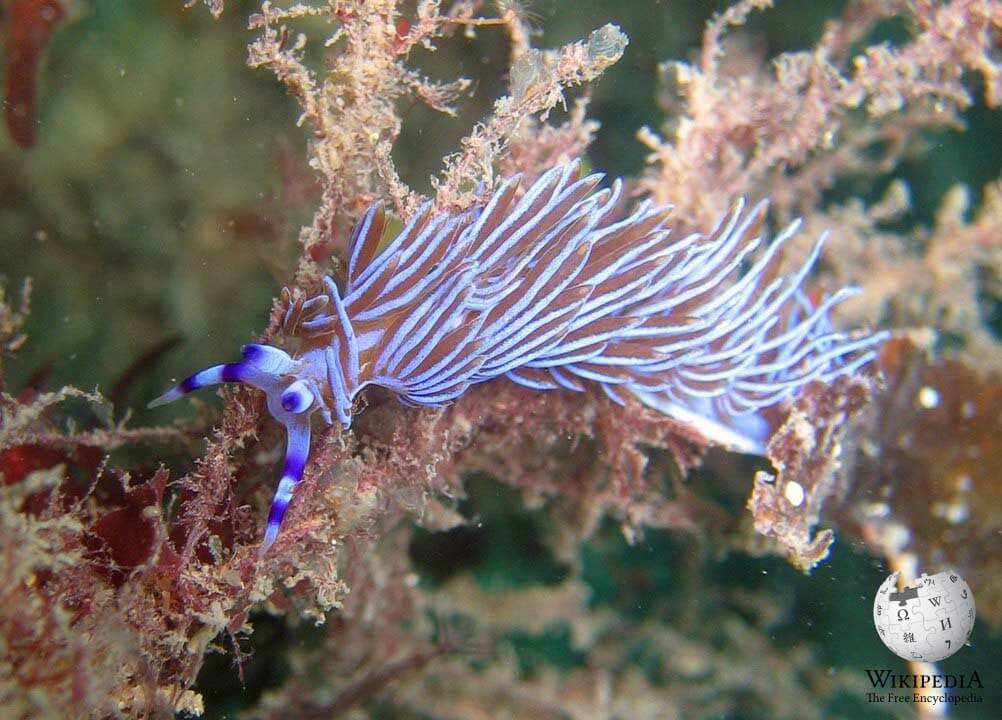
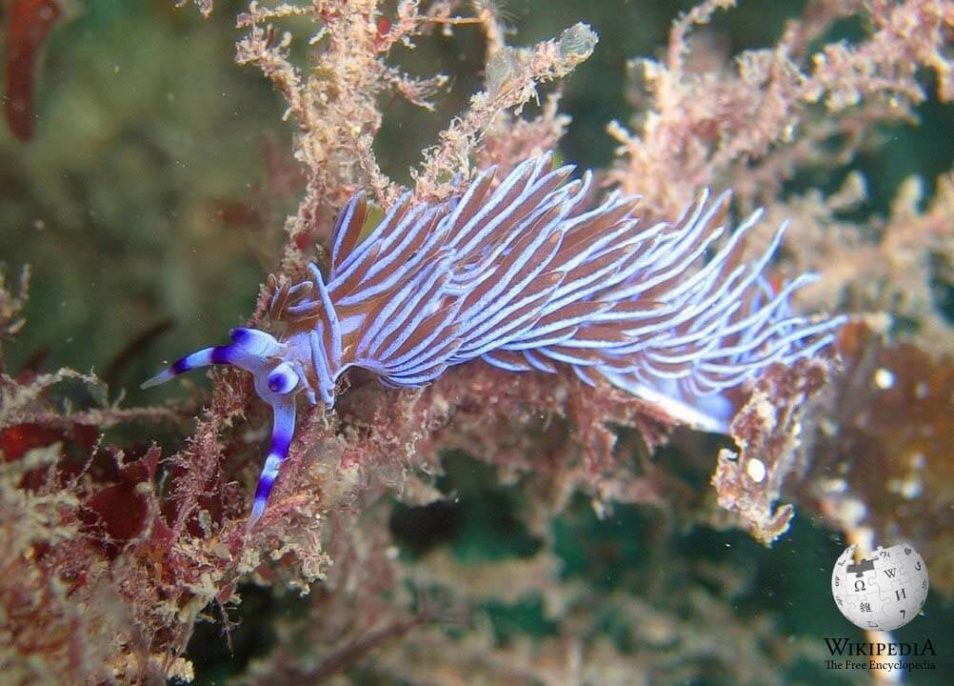


Pteraeolidia ianthina is a sea slug, an aeolid nudibranch in the family Facelinidae.[2][3] It is known as a blue dragon,[4] a name it shares with Glaucus atlanticus and Glaucus marginatus.[5]
Distribution
This species was thought to be widespread throughout the Indo-Pacific, but recent research show that it only lives in the coastal waters of East Australia.[6] There is another species in the genus Pteraeolidia, , which is actually a complex of more than one species.[6][7]
Description
Pteraeolidia ianthina, one of the most common aeolids found, is often called a "blue dragon" by Eastern Australian divers because of its close resemblance to a Chinese dragon.[8] It is one of the most common aeolid nudibranchs found in Eastern Australia and can inflict a painful sting to humans.[9]
The body color of this species is translucent tan, but the cerata, which vary from dark purple to lavender to golden brown, give the nudibranch most of its distinct color.
The slug is elongated (up to 20 cm (7.9 in)) with many clusters of medium-large sized cerata along the length of the body. The cerata do not have any white markings away from the tip.[6] The fat rhinophores are tipped in purple and the long oral tentacles have only 2 dark purple bands. The sides of the body may have purple or brown markings, but no vertical white bars or white spots. Any additional purple bands on the oral tentacles, and/or vertical white bar or spots indicate the animal is part of the Pteraeolidia semperi species complex.[6] White markings on the dorsum are acceptable to a diagnosis of P. ianthina.
Algal zooxanthellae of the genus Symbiodinium derived from the food of these animals continue to photosynthesise inside the body and give rise to brown and pigments that underlay the natural dusty paleness of the animal. Individuals lacking an active zooxanthellate system will appear much paler as a whole.[6] Symbiodinium, together with the nematocysts, are presumed to be derived from coelenterate prey. These Symbiodinium occur within vacuoles in host cells derived from the endoderm.[10]
Young specimens, due to not having consumed much pigment-providing zooxanthellae in their short lives, are completely white[4] (only tips of rhinophores and cephalic tentacles have purple pigment). They are also much shorter and have fewer cerata, thus are often mistaken for other nudibranch species.[11]
Symbiosis with dinoflagellates
This sea slug feeds on hydroids which contain Symbiodinium, microscopic zooxanthellae dinoflagellates that are photosynthetic. The microscopic Symbiodinium acquired from the hydroids are 'farmed' in the sea slug's digestive diverticula, where the Symbiodinium photosynthesizes sugars to be used by the slug. The slug gains enough photosythetically derived sugars to sustain it without feeding.[9][10]
Gallery
 Sydney, Australia
 Sydney, Australia
 New South Wales, Australia
 A juvenile without a zooxanthellate colony to provide pigment.
 The cerata cores are brown, thick with symbiotic zooxanthanellae. Cnidosacs visible just at the tips.
 Closeup of the perfoliate rhinophores.


References
- 1 2 Angas, G.F. (1864). Description d'espèces nouvelles appartenant à plusieurs genres de mollusques nudibranches des environs de Port-Jackson (Nouvelle-Galles du Sud), accompagnée de dessins faits d'après nature. Journal de Conchyliologie. 12(1): 43-70.
- ↑ Korshunova, T.; Fletcher, K.; Martynov, A. (2025). The endless forms are the most differentiated — how taxonomic pseudo-optimization masked natural diversity and evolution: the nudibranch case. Zoological Journal of the Linnean Society. 204(4): zlaf057: 1-93.
- ↑ MolluscaBase eds. (2026). MolluscaBase. Pteraeolidia ianthina (Angas, 1864). Accessed through: World Register of Marine Species on 2026-11-08.
- 1 2 Rudman, W. B. (15 July 2010). "Pteraeolidia ianthina (Angas,1864)". The Sea Slug Forum. Australian Museum. Retrieved 6 July 2019.
- ↑ Salleh, Anna (12 February 2021). "Bizarre 'blue fleet' blows onto Australia's east coast". ABC News. Australian Broadcasting Corporation. Retrieved 13 February 2021.
- 1 2 3 4 5 Wilson N.G. & Burghardt I. (2015). Here be dragons – phylogeography of Pteraeolidia ianthina (Angas, 1864) reveals multiple species of photosynthetic nudibranchs (Aeolidina: Nudibranchia). Zoological Journal of the Linnean Society. 175(1): 119-133.
- ↑ Meshik MN, Antokhina TI, Deart YV, Chichvarkhina OV, Ekimova IA (2026) Dragons guard secrets: integrative systematics of Pteraeolidia semperi species complex (Gastropoda, Nudibranchia) from Vietnam. ZooKeys 1293: 347-376.
- ↑ http://www.philippine-seaslugs.com/AEOLIDINA/Pteraeolidia_ianthina.htm[permanent dead link] Pteraeolidia ianthina
- 1 2 Crew, B. (2019). Beware the dragon: this NSW nudibranch will mess you up. Australian Geographic. Accessed on 2026-11-08.
- 1 2 Sutton, D.C. Hoegh-Guldberg, O. (1990). Interactions in Four Temperate Marine Symbioses; Assessment of Effect of Host Extract on Symbionts. The Biological bulletin, Marine Biological Laboratory. (Woods Hole, Mass.). v. 178 (1990) p. 175]
- ↑ Cory Pittman and Pauline Fiene, 2015. Pteraeolidia semperi Sea slugs of Hawaii
Further reading
- Rudman, W. B. (1982). "The taxonomy and biology of further aeolidacean and arminacean nudibranch molluscs with symbiotic zooxanthellae. Zoological Journal of the Linnean Society 74(2):147-196.
- Yonow, N.; Anderson, R. C.; Buttress, S. G. (2002). "Opisthobranch molluscs from the Chagos Archipelago, Central Indian Ocean". Journal of Natural History 36(7): 831-882. doi:10.1080/00222930110039161
- Richmond, M. (Ed.) (1997). A guide to the seashores of Eastern Africa and the Western Indian Ocean islands. Sida/Department for Research Cooperation, SAREC: Stockholm, Sweden. ISBN 91-630-4594-X. 448 pp. (
- Willan, R. (2009). Opisthobranchia (Mollusca). In: Gordon, D. (Ed.) (2009). New Zealand Inventory of Biodiversity. Volume One: Kingdom Animalia. 584 pp
- Wilson N.G. & Burghardt I. (2015). Here be dragons – phylogeography of Pteraeolidia ianthina (Angas, 1864) reveals multiple species of photosynthetic nudibranchs (Aeolidina: Nudibranchia). Zoological Journal of the Linnean Society. 175(1): 119-133