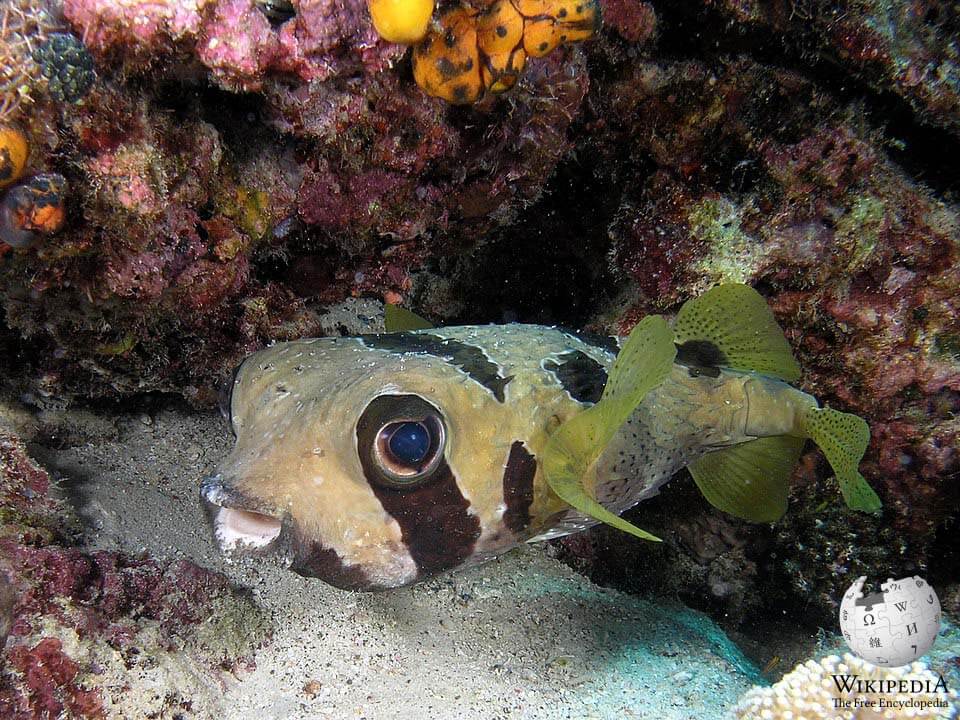
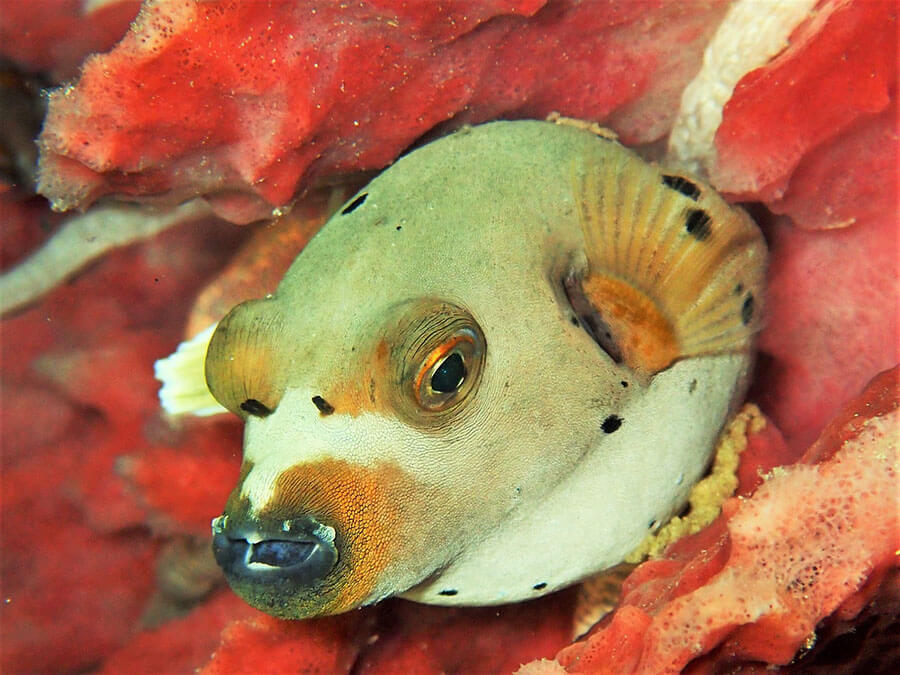
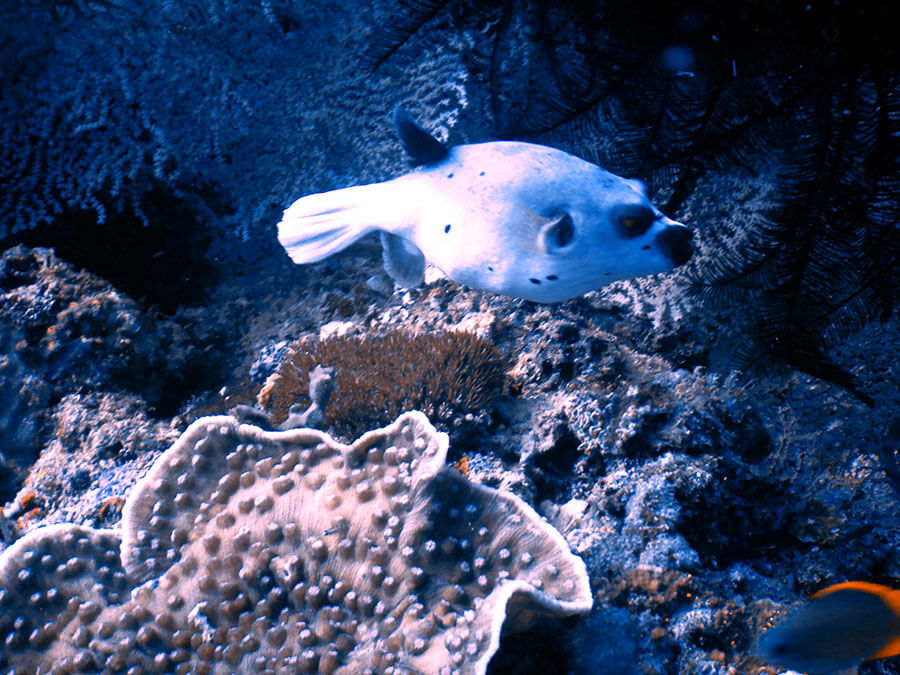


The blackspotted puffer (Arothron nigropunctatus), also known as the dog-faced puffer, is a tropical marine fish belonging to the family Tetraodontidae.
Distribution and habitat
This species is found in tropical waters from the Indian Ocean to the central islands of the Pacific Ocean, roughly equalling the Indo-Pacific, except the Red Sea.[2]
It lives close to external reef slopes and lagoons from the surface to 25 m (82 ft) depth.[3]
Description

Arothron nigropunctatus is a small sized fish which grows up to 33 cm (1 ft) length.[3] Its body is oval shape, spherical and relatively elongated. The skin is not covered with scales. The fish has no pelvic fins and no lateral line. The dorsal fin and the anal fin are small, symmetric and located at the end of the body. Its snout is short with two pairs of nostrils and its mouth is terminal with four strong teeth.[4]
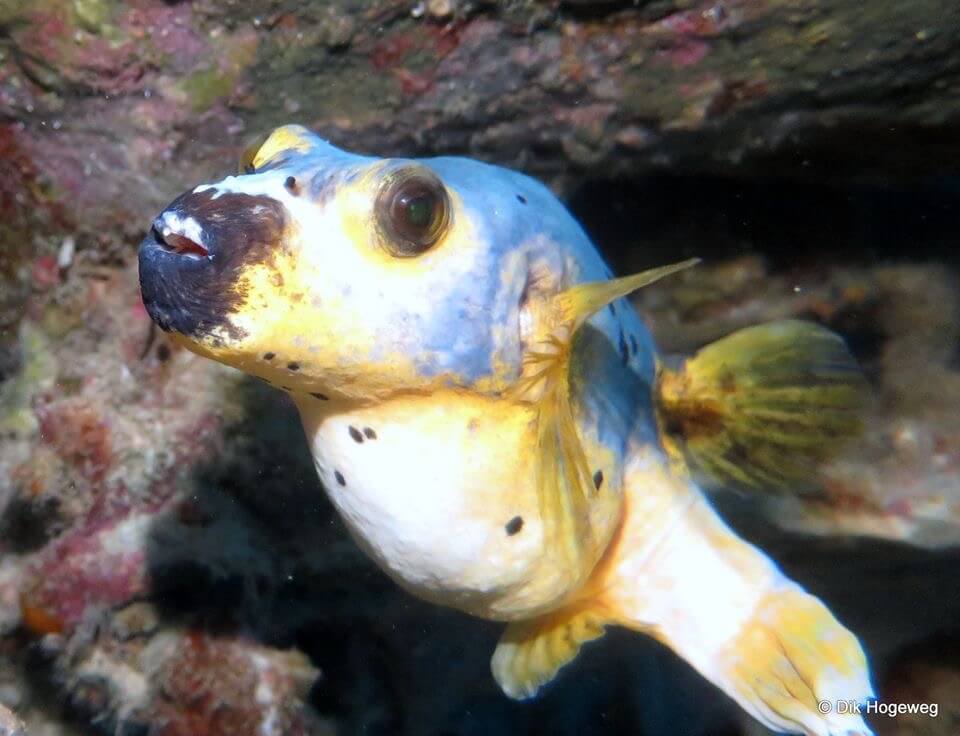
The background coloration is variable and can be grey, light brown, bluish, bluish dark, bright yellow, orangey yellow and also sometimes bi-color like bluish and yellow. Dark coloration occurs around the eyes and the mouth. The skin is strewed with dark blotches which vary in size and shape.[citation needed]
The yellow colour morphs of Arothron nigropunctatus are very similar to the yellow colour morphs of Arothron meleagris, but not indistinguishable. The fully yellow morph is far more common in A. meleagris than in A. nigropunctatus, with 10% and 1% of individuals displaying the fully yellow morph respectively. In A. nigropunctatus, the fully yellow morph usually retains the characteristic dark colouration around the mouth, eyes, and base of the dorsal fin. The same morph in A. meleagris has similar black spots, but is otherwise uniformly yellow all over the body.[5]
Suspected hybrids between the two species have also been observed at Réunion Island. [6]
Feeding
Arothron nigropunctatus feeds on benthic invertebrates, sponges, tunicates, algaes, coral like Acropora tips, crustaceans and mollusks.[2][3]
Behaviour
This pufferfish is diurnal, solitary and territorial.[4]
Defense
Arothron nigropunctatus holds the deadly poison tetrodotoxin, which protect it from predators. In order to ward off potential enemies, they can inflate their bodies by swallowing air or water.
Gallery
 Partially yellow, in the Philippines
 Unusually yellow dorsal fin, in captivity
 In the Philippines
,_Anilao,_Filipinas,_2023-08-24,_DD_19.jpg)

,_Anilao,_Filipinas,_2023-08-25,_DD_64.jpg)
References
- ↑ Shao, K.; Liu, M.; Jing, L.; Hardy, G.; Leis, J.L.; Matsuura, K. (2014). "Arothron nigropunctatus". IUCN Red List of Threatened Species. 2014 e.T193804A2279524. doi:10.2305/IUCN.UK.2014-3.RLTS.T193804A2279524.en. Retrieved 30 December 2021.
- 1 2 "Arothron nigropunctatus (Bloch & Schneider 1801)". The Encyclopedia of Life. Retrieved 2013-05-29.
- 1 2 3 Froese, Rainer; Pauly, Daniel (eds.). "Arothron nigropunctatus". FishBase. November 2006 version.
- 1 2 Lieske & Myers (2009). Coral reef fishes. Princeton University Press. ISBN 9780691089959.
- ↑ Su, Jinxiang; Tyler, James C. (1986). "Diagnoses of Arothron nigropunctatus and A. meleagris, Two Extremely Polychromatic Indo-Pacific Pufferfishes (Pisces: Tetraodontidae)". Proceedings of the Academy of Natural Sciences of Philadelphia. 138 (1): 14–32. ISSN 0097-3157. JSTOR 4064849.
- ↑ Bourjon, P; Chanet, B (2017-12-01). "Two cases of probable hybridisation between the pufferfishes Arothron meleagris (Anonymous 1798) and A. nigropunctatus (Bloch and Schneider 1801) on a fringing reef at Réunion Island". African Journal of Marine Science. 39 (4): 503–507. Bibcode:2017AfJMS..39..503B. doi:10.2989/1814232X.2017.1393005. ISSN 1814-232X.
External links
- Photos of Blackspotted puffer in the Sealife Collection